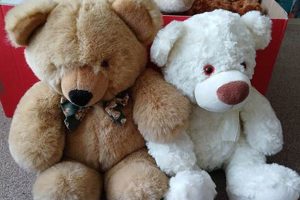
A system of classification and identification for plush toys resembling bears employs various characteristics, including manufacturer, date of production, material composition, and specific design features. For instance, Steiff bears often feature a button in their ear, a key identifier for the brand. These distinguishing attributes enable collectors and enthusiasts to categorize and value these items accurately.
Accurate categorization provides crucial information for valuation, preservation, and historical research. Understanding the lineage and specific attributes of a plush toy bear allows for informed decisions regarding its care, potential market value, and significance within the broader context of toy manufacturing and collecting. This knowledge base is constantly evolving as new information and manufacturing techniques emerge.
The following sections will delve deeper into the various aspects of plush toy bear identification, including specific manufacturer markings, dating methods, and resources for further research.
Tips for Plush Toy Bear Identification
Effective identification requires careful observation and research. The following tips provide guidance for navigating the process.
Tip 1: Examine the Construction Material. Mohair, synthetic plush, and other fabrics offer clues to the era of production. Early plush toys often utilized mohair, while later examples might feature synthetic materials.
Tip 2: Locate Manufacturer’s Marks. Buttons, tags, and embroidered symbols can indicate the maker. Research these markings to determine the brand and potential date ranges.
Tip 3: Analyze Facial Features. Eye type, nose shape, and mouth stitching vary between manufacturers and eras. These details can be crucial for accurate identification.
Tip 4: Assess the Overall Condition. Wear, repairs, and alterations can provide valuable insights into a plush toy bear’s history. While impacting value, these factors can contribute to its unique story.
Tip 5: Consult Reputable Resources. Books, online databases, and collector communities offer valuable information and expertise for accurate identification.
Tip 6: Document Findings. Photographing or sketching distinct features ensures accurate record-keeping for future reference and comparison.
Through diligent examination and research, one can uncover valuable insights into the history and significance of a plush toy bear.
These identification tips provide a foundation for informed collecting, preservation, and appreciation of these treasured items. Further sections will explore specific examples and resources for advanced research.
1. Manufacturer

The manufacturer plays a crucial role in plush toy bear identification. Establishing the maker often provides a foundation for understanding a bear’s date of production, materials used, and overall design characteristics. Specific manufacturers employ unique construction methods, materials, and identifying marks. For example, Steiff bears often feature a button-in-ear tag, a hallmark of the brand. Similarly, Merrythought bears frequently display specific labels and tags. Identifying the manufacturer often serves as the first step in a broader identification process.
Knowledge of the manufacturer allows collectors and researchers to access specialized resources and databases tailored to specific brands. These resources can offer valuable insights into production dates, material variations, and unique design characteristics specific to the manufacturer. This knowledge contributes to a deeper understanding of the plush toy bear’s history and potential value. For instance, identifying a bear as a Steiff product allows researchers to leverage the extensive Steiff archives and collector communities to pinpoint the specific model and production year.
Determining the manufacturer is paramount for accurate plush toy bear identification. This knowledge unlocks access to specialized resources, informs valuation, and facilitates a more comprehensive understanding of the item’s historical context and significance. While challenges exist in identifying unmarked or less well-documented manufacturers, focusing on construction techniques and material analysis can still provide valuable clues. This understanding underscores the importance of the manufacturer as a key component within the broader framework of plush toy bear identification and collecting.
2. Date of Production
Establishing the date of production is essential for accurate plush toy bear identification. Production date directly influences material composition, manufacturing techniques, and stylistic elements. This information provides crucial context for understanding a bear’s historical significance and potential value. For example, bears produced during World War I often exhibit material substitutions due to wartime shortages. Identifying these variations requires an understanding of production timelines and historical context.
Pinpointing the production date often involves analyzing a combination of factors. Manufacturer markings, material composition, and stylistic elements provide clues. Early plush toy bears frequently utilized mohair, while later examples might incorporate synthetic materials. Button styles, ear tag designs, and facial stitching techniques also evolve over time, offering further indicators of the production era. Researching specific manufacturers and their production histories can provide detailed timelines and catalogs, aiding in accurate dating. For instance, Steiff’s meticulous record-keeping allows collectors to pinpoint the production year of many of their bears based on button and tag variations.
Understanding the date of production allows collectors and researchers to place the plush toy bear within its proper historical context. This knowledge informs assessments of value, rarity, and significance within the broader history of toy manufacturing. While challenges exist in dating bears lacking clear manufacturer markings or documentation, careful analysis of material and stylistic elements, combined with research and consultation with experts, can often provide a reasonable estimate of the production era. This understanding of production date strengthens the overall identification process and enhances the appreciation for these historical artifacts.
3. Material Composition

Material composition plays a critical role in plush toy bear identification. The materials used in a bear’s construction offer valuable clues about its age, manufacturer, and potential value. Different eras favored distinct materials. Early bears often featured mohair, a natural fiber derived from the Angora goat, prized for its soft texture and durability. Later, synthetic plush materials, such as rayon and nylon, became prevalent. Identifying the material provides a temporal anchor point, narrowing down the potential production period. For example, a bear made of mohair likely predates the widespread adoption of synthetic plush. Furthermore, certain manufacturers favored specific materials, aiding in brand identification. Steiff, known for high-quality craftsmanship, extensively used mohair in their early bears. Therefore, the presence of mohair, combined with other characteristics, could suggest a Steiff origin.
Analyzing material composition goes beyond simply identifying the primary fabric. Stuffing materials also offer valuable clues. Early bears might contain excelsior (wood wool), straw, or kapok. Later examples frequently utilized synthetic fillings. Examining the stuffing can corroborate other dating indicators and offer insights into the manufacturing techniques of a specific period. For instance, the presence of excelsior suggests an earlier production date compared to synthetic fillings. Moreover, assessing the condition of the material offers further insights. Signs of wear, fading, or repairs, considered alongside the material type, can provide a more nuanced understanding of a bear’s history. A well-preserved mohair bear might indicate careful storage, potentially increasing its value.
Understanding material composition is crucial for accurate plush toy bear identification. It provides a framework for dating, identifying potential manufacturers, and assessing overall condition. This knowledge enhances the ability to place a bear within its proper historical context and appreciate its unique characteristics. While challenges exist in identifying materials without destructive testing, visual inspection and tactile analysis, combined with research and expert consultation, usually suffice. This understanding of material composition enhances the overall identification process and deepens the appreciation for these treasured objects.
4. Distinguishing Features
Distinguishing features serve as critical components of plush toy bear identification, providing specific markers that differentiate individual bears and contribute significantly to their overall “ID.” These features often represent unique manufacturing techniques, design choices, or historical anomalies, offering valuable clues for collectors and researchers. The presence, absence, or specific variation of these features can be instrumental in determining a bear’s maker, age, and overall rarity. For instance, a Steiff button-in-ear, with its specific variations in color, size, and embossing, acts as a powerful identifier, instantly signaling the brand and potentially narrowing down the production period. Similarly, the presence of a hump on a bear’s back, a characteristic common in early Steiff bears, further refines the identification, potentially pointing to a specific model or production era. Beyond manufacturer-specific markings, other distinguishing features include facial stitching patterns, paw pad designs, and the use of unique materials or embellishments. These details, while seemingly minor, contribute significantly to a bear’s individuality and serve as crucial markers for identification purposes.
The careful examination and documentation of distinguishing features enable researchers and collectors to build comprehensive profiles for individual bears. These profiles, incorporating information about the manufacturer, material composition, and date of production, provide a robust framework for accurate identification. Moreover, understanding the significance of specific distinguishing features enhances the ability to differentiate between genuine examples and reproductions. Counterfeiters often overlook or misrepresent subtle details, making the knowledge of authentic distinguishing features a valuable tool for authentication. For instance, the specific stitching pattern on a bear’s nose or the precise placement of its eyes can distinguish an original Steiff from a later imitation. The practical application of this understanding extends beyond authentication; it informs valuation, enabling collectors and appraisers to accurately assess a bear’s market value based on its unique combination of features. A rare or unusual feature, such as an early experimental button design or an uncommon material variation, can significantly impact a bear’s desirability and price.
Distinguishing features are integral to the process of plush toy bear identification. Their meticulous analysis provides essential information regarding a bear’s manufacturer, age, and rarity, enabling accurate identification, authentication, and valuation. While challenges exist in identifying and interpreting less well-documented features or variations, continued research and collaboration within collector communities contribute to the ongoing refinement of the knowledge base surrounding these important markers. This understanding of distinguishing features strengthens the overall framework for plush toy bear identification and enhances the appreciation for these historical artifacts.
5. Provenance Documentation

Provenance documentation plays a crucial role in establishing a comprehensive “teddy bear id.” It provides verifiable evidence of a bear’s history and ownership, significantly impacting its authenticity, value, and historical significance. This documentation can include original purchase receipts, auction records, family photographs featuring the bear, or even written accounts passed down through generations. These records offer a tangible link to the past, connecting a specific bear to its previous owners and historical context. For example, a bear accompanied by a photograph showing a child holding it in the 1920s provides compelling evidence of its age and provenance, strengthening its identification and potentially increasing its value. A documented history adds a layer of authenticity and storytelling, transforming a simple plush toy into a tangible piece of history. A bear with documented provenance from a prominent historical figure or event gains significant historical value, surpassing its intrinsic value as a collectible.
Provenance documentation strengthens the identification process by corroborating other identifying markers. A manufacturer’s tag might identify a bear as a Steiff, but a corresponding sales receipt from a reputable antique dealer specializing in Steiff bears further solidifies the identification and provides additional information about its acquisition history. This combination of physical characteristics and documented provenance creates a more complete and reliable identification. The impact of provenance documentation extends beyond individual bears; it contributes to the broader understanding of plush toy bear history. Documented examples with established provenance help researchers and collectors build timelines of production, identify regional variations in design and materials, and trace the evolution of manufacturing techniques. This information strengthens the collective knowledge base and enhances the ability to identify and authenticate other bears lacking such comprehensive documentation.
Provenance documentation is an essential component of establishing a definitive teddy bear id. While the physical characteristics of a bear provide a foundation for identification, documented provenance enhances authenticity, informs historical context, and strengthens overall value. The absence of documentation does not necessarily diminish a bear’s intrinsic value or historical significance, but its presence adds a layer of verifiable authenticity and provides valuable insights into its individual journey through time. Challenges exist in verifying the authenticity of provenance documentation itself, and careful scrutiny and authentication processes are essential to ensure accuracy and prevent fraudulent claims. This understanding of the importance of provenance documentation underscores its crucial role within the broader framework of teddy bear identification and collecting.
Frequently Asked Questions
This section addresses common inquiries regarding plush toy bear identification, providing concise and informative responses.
Question 1: How can one differentiate between an antique plush toy bear and a modern reproduction?
Careful examination of materials, construction techniques, and manufacturer markings provides key indicators. Antique bears often exhibit specific material characteristics, such as mohair plush or early synthetic fillings, distinct from contemporary materials. Construction techniques, including hand-stitching versus machine stitching, also offer clues. Authentic manufacturer markings, researched for period accuracy, are essential for authentication. Consulting expert resources and reputable dealers aids in informed assessment.
Question 2: What is the significance of a button-in-ear tag on a plush toy bear?
Button-in-ear tags often serve as manufacturer identifiers, particularly associated with the Steiff brand. Variations in button design, size, and embossing can indicate specific production periods and models. Researching these variations within the context of Steiffs historical production records assists in accurate dating and authentication. However, the presence of a button-in-ear tag alone does not guarantee authenticity, as reproductions may incorporate similar features.
Question 3: How does material composition contribute to plush toy bear identification?
Material composition provides essential clues to a bear’s age and potential manufacturer. Early bears often utilized mohair, while later examples employed synthetic plush. Stuffing materials also offer insights, with early bears featuring excelsior, straw, or kapok, while later examples often contain synthetic fillings. Analyzing material composition requires careful observation and research of historical manufacturing practices.
Question 4: Where can one find reliable resources for plush toy bear identification research?
Reputable resources include specialized books on antique toys and plush toy bears, online databases maintained by collector organizations, and reputable antique dealers specializing in plush toys. Museum archives and library collections often hold valuable historical catalogs and manufacturing records. Consulting with experienced collectors and appraisers can provide additional expertise.
Question 5: What steps should be taken when documenting a plush toy bear for identification purposes?
Detailed photographs capturing all angles of the bear, including close-ups of distinguishing features such as facial stitching, paw pads, and manufacturer markings, are essential. Written descriptions noting material composition, condition, and any unique characteristics supplement photographic documentation. Maintaining organized records of research findings and consulting with experts ensures comprehensive documentation.
Question 6: How does the condition of a plush toy bear influence its value and identification?
Condition plays a significant role in both value and identification. While wear and repairs can diminish value, they also provide insights into a bear’s history. Original condition, with minimal wear and no repairs, generally commands higher value, particularly for rare or antique examples. However, even well-loved bears with repairs can hold significant sentimental or historical value. Assessing condition requires careful evaluation of wear patterns, repairs, and overall structural integrity.
Accurate plush toy bear identification requires a combination of careful observation, meticulous research, and consultation with reliable resources. These FAQs provide a starting point for navigating the identification process and encourage further investigation to deepen understanding and appreciation for these treasured items.
The subsequent sections delve into specific case studies illustrating the practical application of these identification principles.
Teddy Bear Identification
Accurate identification of plush toy bears relies on a multifaceted approach encompassing manufacturer identification, dating, material analysis, and the examination of distinguishing features. Provenance documentation, when available, significantly strengthens the identification process and provides valuable historical context. Each of these components contributes to a comprehensive understanding of a bear’s unique identity and its place within the broader history of plush toy manufacturing and collecting. The information presented within this document provides a framework for navigating the complexities of teddy bear identification.
The ongoing study and documentation of plush toy bears remain essential for preserving their historical significance and ensuring accurate identification for future generations. As new information emerges and research methodologies evolve, the collective understanding of these treasured objects continues to deepen. Continued collaboration among collectors, researchers, and institutions will further refine the knowledge base surrounding teddy bear identification, fostering greater appreciation for their historical and cultural value.